|
Linking
Transportation and Land Use to Create Thriving Communities
The Genesee
Transportation Council (GTC) is the designated Metropolitan Planning
Organization (MPO) for the Genesee-Finger Lakes Region. GTC is responsible
for federally-funded transportation policy, planning, and decision making,
including highways, bridges, public transportation, bicycles, and
pedestrians. Federal law and regulations require that all communities with
more than 50,000 residents have an MPO and a continuing, cooperative, and
comprehensive transportation planning process in order to receive federal
transportation funding.
Local planning
requires thinking about the regional transportation system. Changes in
population and employment within the region largely determine where people
go, how often they go there, and what they want and need when they get
there. While land use planning takes place at the local level, GTC helps
communities understand how their plans and those of other communities can
support coordinated transportation decision making so that we don’t
duplicate efforts or waste resources. The end goal is a responsive regional
transportation system that serves everyone well.
The Transportation-Land Use Connection
One of the principal services that GTC provides is
helping people recognize the connection between transportation and
quality of
life. Transportation facilities such as streets, parking lots, and
even driveways occupy a significant portion of our land.
Transportation is a required activity that can be frustrating or
enjoyable.
It is also expensive for our families to own and
operate personal vehicles and our communities to build and maintain
roads and other
transportation infrastructure, as well as provide
public transportation. |
|
|
With a
little planning and foresight, we can make our transportation
experiences more enjoyable and less expensive for all of us.
GTC funds
planning studies to improve traffic circulation, parking, safety, and
aesthetics. For over a decade, GTC funds have been used to coordinate
transportation and land use planning in such diverse communities as
Hilton, Macedon, Perry, Spencerport, Geneseo, and the Brown’s Square
neighborhood of the City of Rochester. We also
sponsor studies of
major urban, suburban, and rural
corridors throughout the region. The corridor studies are often
multi-jurisdictional, recognizing that the benefits and impacts of
transportation facilities and services do not begin or end at
municipal boundaries. |
|

Village of Fairport |
|
This web resource is intended to share insights for
connecting transportation and land use planning from these model
projects and other examples around the
nation. Through many years of research and experience, GTC has gained
considerable knowledge about the elements that successfully connect
transportation and land use, as well as the dynamics of planning
processes that can lead to success. The links in the text will direct
you to more information about particular topics. |
|
|
|
|
|
|
Common Elements of Success |
|
|
|
|
|
|
Let’s start
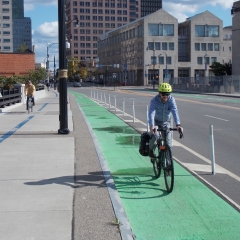
by considering sidewalks. Sidewalks are probably our most-used public
gathering places. They’re great for people of all ages. They can help
knit communities together. So a good way to make the transportation
experience more enjoyable is by planning for sidewalks, if there are
none, and maintaining those which already exist. |
What’s at stake for villages/
neighborhoods/corridors?
-
Traffic
circulation and truck access.
-
Economic development
opportunities.
-
Parking
solutions.
-
Appropriate and efficient scale,
connectivity, and continuity.
-
Downtown/neighborhood/corridor vitality.
-
“Image,”
“Pride,” and the ability to distinguish/market your community as special.
GTC Circulation, Accessibility,
and Parking Studies:
GTC Corridor
Studies:
Summary Matrix
|
|

Proposed sidewalk and streetscape enhancements,
Village of Hilton |
The more
places we can get to by sidewalks, the more we are likely to use them
instead of driving. Some of our cities and villages have a pattern of
interconnected streets and sidewalks. But many of us live in
subdivisions that end in cul-de-sacs. Cul-de-sacs are a fancy name for
dead ends. |
|
If we’re planning for future growth, we may want to consider requiring
new subdivisions to have streets and sidewalks that connect with
neighboring parcels
so that a system of connected paths can be created over time. If we live
in a community with an
established sidewalk network, we may want
to fill in any gaps — particularly around schools, parks, and
libraries — and make sure we have a program for maintaining our
sidewalks.
Creating
walkable communities
and recognizing the benefits of sidewalks for providing
safe routes
to school are national as well as local trends.
Walking and
biking — besides offering another way to get from here to there — are
an enjoyable way to exercise, great for the cardiovascular and
respiratory systems.
For many of
us, no matter where we live, if we are walking, we will come to a busy
road or highway that can be intimidating for pedestrians or
bicyclists.
Intersections and crosswalks can be made friendlier with bump outs and
center medians, where appropriate, to reduce the number of traffic
lanes that have to be crossed, or raised crosswalks — sometimes called
speed tables — to make cars slow down. |
|
Traffic
signals can be timed to allow
more time to cross, and pedestrian
warning signals are available that can provide more information than
just the usual cross and don’t cross. In-pavement crosswalk lighting
also addresses some of the safety concerns of crossing a busy street. |

|
|
Proper,
uncluttered, and unambiguous signage also gives clear signals to
motorists, bicyclists, and pedestrians that they are sharing the same
road, which is important for safety and peace of mind.
Our major
arterials are often our major commercial and shopping corridors. We
might like them to have more social interaction, but traffic flow
can’t be ignored. |

Village of Spencerport |
GTC Fact Sheets
GTC
Web Topics
|
|
That said,
certain undivided four-lane highways can often be successfully
converted to three lanes, including a center two-way turning lane —
freeing up space for new on-street parking, wider sidewalks, curb
extensions, landscaping, improved bus stops, or bicycle lanes. |
|


Subdividing
large plazas increases design and
transportation options |
In addition
to the various road enhancements for
safety and
access
management we just noted, the solution may include site and
building design, such as subdividing large shopping centers to create
a block pattern of infill development with pedestrian walkways between
the buildings; making sure buildings are set close to the sidewalk;
and designing front facades with lots of windows for passersby.
The street-level experience can also be enhanced by gateway
treatments, bicycle racks and parking, decorative street lights, retaining
walls, and other context sensitive design elements that improve
transportation, as well as aesthetics.
|
|
Street
trees are a very important element, both functionally and
aesthetically. Street trees provide color and shade and make a
nice buffer between moving
traffic and
pedestrians.
Parking is
a major concern for businesses and patrons. More and more
communities across the country are requiring parking lots to be at the
rear or
sides of
buildings or on the street, so pedestrians don’t have to walk across
parking
lots to get to stores.
Communities
are also becoming more conscious of not requiring too much
parking and
making sure onsite parking areas are well-landscaped. Areas can
be
landscaped with grassy pavers to provide additional parking during
peak business periods.
|

Proposed context sensitive design elements,
Village of Macedon |
|

Proposed
gateway, Town of Williamson |
Shared
parking agreements between, for example, a business that is open only
days and a neighboring restaurant that is open only evenings can also
reduce the need for parking spaces and accommodate peak periods —
requirements for both establishments.
There’s a
movement going on around the country and in this region for mixed-use,
infill development. It’s the idea that putting shops and services next
to housing is much more convenient for people and reduces
infrastructure costs. This is a great concept for certain geographic
areas and markets.
However,
mixed-use is not feasible for all built environments.
The typical |
|
post-World War
II suburb in our region, for example, lacks the economic
characteristics and density necessary to support a mix of uses. The
low density and the nature of most personal trips also make it
impractical at the present time to redesign bus routes to directly
serve most residential suburbs with public transportation. |
|
Many of our
villages and urban neighborhoods already have traditional main
streets
with mixed-use development and walkable neighborhoods that serve
patrons and
visitors from the entire region, as well as the immediate area. Our
cities and villages have a sense of place that would be costly, if not
impossible, to duplicate if they were lost. Our historic centers are
unique resources that should
be
appreciated and preserved.
Our rural
areas are also unique and must be cherished. Rural hamlets, villages,
and
traditional commercial areas can be preserved through cluster, large
lot, historic districts, and other zoning techniques that recognize
the unique rural character. Conservation easements, agricultural
districts, and other tools can protect farmland. |

Traditional mixed-use, Village of Waterloo |
|
 |
Highways
can add to the protection of rural communities and landscapes with
careful attention to design and safety standards (especially when
passing through populated areas), improved access to recreation
opportunities and scenic views, interpretive signage, and marketing
efforts.
As noted,
GTC has been involved in several rural corridor studies.
Another
very important way land use and transportation are integrated in our
region is through multi-use trails. Our region has one of the
finest trail systems in the entire United States. Trails promote
healthy transportation options, increase our sense of connection with
nature, whether we live in urban, suburban, or rural communities, and
should be a consideration in our planning efforts.
|
What We Learned
-
A
sense of place, quality of life, and economic vitality can be
improved with thoughtful planning and development.
-
Coordinated land use and transportation planning is crucial to
ensure that limited public resources are put to the best use
and to
attract private investment.
-
Most
development will be driven by the private sector.
-
GTC
must continue to provide guidance, assistance, and financial
incentives to coordinate transportation and land use planning.
|
|
|
|
|
Dynamics of a Successful Planning Process
Communities
set the direction in which they want to go and the tone and content of
discussion through the planning process. |
|
Each
planning process, like each community, is unique. There is no “one
size fits all” way of integrating land use planning and transportation
planning. However, in our experience, public processes that result in
successful plans share the following essential steps: |
Every
community should ask the
same questions, but not expect the same
answers. |
|
-
Identify
issues to be resolved, from the beginning and throughout the
process.
-
Inventory
existing and future socioeconomic, environmental, and infrastructure
conditions.
-
Assess
needs and opportunities relative to the issues to be resolved and
conditions.
-
Formulate
alternatives to address the needs and maximize the opportunities.
-
Choose
the preferred alternative(s) that provide the most benefits relative
to costs.
In other
words, every community should ask the same questions, but not expect
the same answers. |
|
What are
some of the questions?
Do
neighbors have convenient opportunities to meet one another?
Are most
shopping areas inviting?
Can some
daily needs be met by walking?
Can
residents bike safely to parks, schools, or other places?
Where do
people like to gather? Can we get there without driving?
What are
the resources that truly define our community, that we must
protect
and make more accessible? |

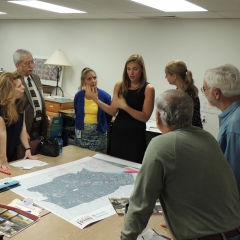
Village of Perry public workshop
|
|
What
economic uses are dependent on vehicles, and how do we incorporate this
with other considerations? |
|
As
communities work through these types of questions — and there most
likely will be many others — they begin to commit themselves to
creating thriving communities for current and future residents while
enabling economic prosperity.
The
recommended process is a framework for analyzing questions in their
proper context. It helps communities to avoid overlooking or
overemphasizing important issues and to recognize connections and
relationships between transportation, land use, and quality of life. |
|
Small
Changes that Make a BIG Difference
Long-term planning
can take time, but a community may need to make improvements quickly.
Click
here to learn about small, affordable interventions that can
provide new energy to a community. They can work on their own to
improve a community’s appearance, vitality, and prospects, or provide
assistance during the planning process.
|
|
Money Counts
We’ve seen
the safety, environmental, health, aesthetic, and
other quality-of-life benefits of creating livable communities.
There are
also financial benefits.
|
Transportation
investments
influence development patterns, and development patterns
determine travel patterns. We have the ability to shape both
transportation and land use to our advantage. |
|
It’s
cheaper to maintain and improve our existing transportation system
than to build new roads and bridges. It’s cheaper to integrate land
use and transportation so that, over time, we reduce traffic
congestion, infrastructure costs, and air pollution. The most
cost-effective land use and transportation planning is based on
leveraging and preserving our existing investments.
Federal and
state funding for transportation is now more limited than it’s been
for a very long time, placing the funding burden squarely on the
shoulders of local governments. In other words, it is imperative for
us to find ways to reduce expenses (or accept that our roads and
bridges have to deteriorate further).
Because the
region’s transportation needs far exceed available resources, GTC and
the state must prioritize where limited funds are directed and how
they are spent. Consequently, communities that incorporate
transportation considerations into land use planning will likely
identify more cost-effective projects and have an advantage for
funding. For example, a municipality may have the legal right to
approve a land use that generates a large amount of vehicle trips that
exceed the capacity of local roadways, but then the municipality
should look to the developer to mitigate the impacts of its project
and not expect the region to utilize state or federal funds to pay for
the ensuing delay the project will create.
The
important thing to remember is that we can — and must — impact the
individual and social costs of transportation through improved
integration with land use planning at the local and regional levels.
How GTC Can Assist
Beyond
providing this and other online resources, GTC also offers technical
assistance to communities that are interested in considering how they
can better coordinate their land use planning and regional
transportation considerations.
GTC
provides technical assistance by working with communities to identify
the steps necessary to more fully integrate land use and
transportation decision making, and then directing them to the
resources and providing the data necessary to take these steps –
either on their own or with the help of professional planning
consultants.
As
resources permit, GTC also makes federal transportation funds
available to communities to conduct a variety of planning activities,
including (but not limited to) preparing coordinated transportation
and land use plans for corridors, neighborhoods, and main streets. For
more information on plans and studies underway and completed using
these federal transportation planning funds, please review the
“Unified Planning Work Program” and the “Plans & Studies” (see
specifically Tasks 6800 through 7600) on the GTC website. |
|
|
|
|
|
|
|
|
|
|
|