Context Sensitive Design


●  What is Context Sensitive Design?

●  Benefits of Context Sensitive Design

●  Special Considerations

●  How a Community Can Get Involved

●  Regional Examples of Context Sensitive Projects

●  Other Context Sensitive Design Resources


In the past, transportation planners and engineers were often more concerned with the efficiency, capacity, and safety of a roadway for motor vehicles than on the impacts such roads may have on the surrounding environment and communities they serve. This approach often created undesirable conditions, including excessive vehicle travel speeds, unsafe environments for pedestrians, the loss of convenient on-street parking, and adverse affects on local businesses.


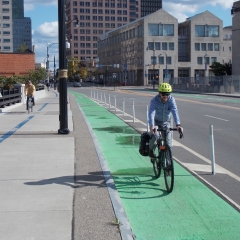
Recently, transportation planners and engineers have begun utilizing a new approach to roadway design called Context Sensitive Design (CSD), also referred to as Context Sensitive Solutions. CSD seeks to design new roadways or modify existing ones to suit all users – motor vehicles, bicyclists, pedestrians, and public transportation passengers. Additionally, CSD seeks to preserve and enhance the character of the surrounding community. Moreover, CSD strives to balance the economic, social, and environmental objectives of the community with the operational needs of the roadway.


What is Context Sensitive Design?


The New York State Department of Transportation (NYSDOT) defines Context Sensitive Design as “a philosophy wherein safe transportation solutions are designed in harmony with the community. It is not a separate process or set of standards... [but] is a philosophy that guides NYSDOT in all phases of project development.” CSD strives to balance environmental, scenic, aesthetic, cultural, and natural resources, as well as community and transportation service needs. Context sensitive transportation projects are designed, built, and maintained to minimize disruption to the community and the environment and to enhance livability. 


In considering ways to address the issue of high volumes of traffic, CSD changes a process that may have previously limited options to widening the road, narrowing or excluding sidewalks, and other remedies that focus only on the safe and efficient passage of increased motor vehicle traffic, possibly at the expense of other roadway users and the community at-large. 


CSD takes the process beyond this to include specific design solutions that address the concerns of local residents, businesses, and/or others.  It also looks at the context in which the roadway is or will be located. Context is everything related to the people and place where the road is located.


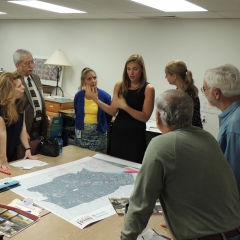
Another trademark of CSD is the use of a collaborative planning process involving transportation professionals, local officials, and the public. It stresses the early involvement of key stakeholders to ensure that transportation projects are not only safe and efficient for motor vehicles but that they are also safe and efficient for other roadway users as well as in harmony with the natural, social, economic, and cultural environment. 


CSD requires not only early involvement of stakeholders but also a continuous commitment to public involvement, flexibility in exploring new solutions, and an openness to innovative ideas. Stakeholders play an important role in identifying issues and associated solutions that may better meet and balance the needs of the community. 


Several states including New York, Minnesota, Washington, Utah, Maryland, and Kentucky have adopted CSD principles into their transportation planning processes. The New York State Department of Transportation has two CSD goals:

  • Implement and promote Context Sensitive Solutions in the project development process; and

  • Implement and promote early and continuous public involvement in the project development process.  

The Minnesota State Department of Transportation (MNDOT) views CSD as “the art of creating public works projects that meet the needs of the users, the surrounding communities, and the environment.” MNDOT integrates projects into the context or setting where they are located through careful planning, consideration of different stakeholder perspectives, and tailoring designs to specific project circumstances.


In the State of Nevada, CSD goals are identified in the State’s Highway System Master Plan (the link to this document is provided in the Resources section below). Likewise, Governor Kenny Guinn of Nevada stated that:


“Our highways give form to our communities and impact us every day of our lives. They connect us to each other and to the place we have chosen to call home. They welcome our guests upon arriving and send them on their way when they leave. Because they affect our ecosystems and the way our neighborhoods and places of business connect to each other, they influence the quality of life of every citizen in the state.” (2003)


[Back to Top] 

Benefits of Context Sensitive Design


Several benefits of employing CSD principles in project development and implementation include:

  • Stronger working relationships among public agencies, communities, and citizens

  • Designs that better accommodate community and agency objectives

  • Improved acceptance of final project design

  • Potentially lower project costs

  • Expedited project approvals

  • Good business practice

[Back to Top] 

Special Considerations Regarding Context Sensitive Design


Transportation professionals are typically focused on utilizing accepted design guidance, improving safety, minimizing liability, and maintaining reasonable project costs. 

With respect to accepted design guidance and safety, the American Association of State Highway and Transportation Officials (AASHTO) provides nationally accepted highway design guidance in its publication, A Policy on Geometric Design of Highways and Streets (also known as the “Green Book”). Notably, the “Green Book” does include flexibility to accommodate context sensitivity in transportation projects while still meeting accepted design practices, improving safety, and addressing liability concerns. 

In 1998, the Federal Highway Administration (FHWA) published Flexibility in Highway Design that highlighted examples of the flexibility already contained in the “Green Book” in an effort to support roadway design that is responsive to safety needs and community goals. 

Sometimes, the roadway design that is responsive to community needs and sensitive to the natural and/or built environment is not the one with the lowest cost. However, the benefits of a well-designed roadway to the community may outweigh any increase in project cost that contextually sensitive designs may require. Involving the public in a genuine fashion and incorporating their needs help avoid project delays and promote goodwill with. Quality investments in public space typically yield more interest and private investment in a community.


[Back to Top] 

How a Community Can Get Involved


AASHTO and the Project for Public Spaces, a not-for-profit organization dedicated to placemaking and the protection of public spaces, offer the following eight-point process to communities interested in utilizing CSD in transportation or other community projects:

  • Get out “on the street” – experience it from a pedestrian’s point of view

  • Seek out partners – develop a shared vision for the project

  • Get the word out – let the community know something is beginning before any formal discussions

  • Be flexible – remember that every environment has its own special conditions

  • Get started – many early steps can be low-cost and can help show progress toward the shared vision

  • Evaluate, refine, and phase construction – test short-term improvements to see how they are working. Ask users for suggestions about possible improvements or adjustments

  • Keep the big picture in mind – use short-term changes as stepping-stones, keeping in mind the broader livability and environmental concerns of the community


[Back to Top] 


Other Context Sensitive Design Resources


x

Directions to GTC


GENESEE TRANSPORTATION COUNCIL

City Place, 50 West Main Street, Suite 8112

Rochester, NY 14614-1227

Phone:  (585) 232-6240      Fax:  (585) 262-3106


www.gtcmpo.org


E-mail Us 


Copyright © 2008 Genesee Transportation Council